Getting Medieval
Announcing a new Substack series
I’m pretty sure that this isn’t the kind of line that Substack gurus encourage writers to open with in order grab their readers’ attention, but here goes: I am a medievalist by training, and if that period is unknown territory to you, I’d love to take you there over the next while!
Almost thirty years ago, I enjoyed some of my first extended exposures to medieval literature as a young undergraduate student at Queens University Belfast, and I was hooked. The later medieval period is a fascinating era in history, full of events, people, and cultural artefacts that are simultaneously like and unlike us in the twenty-first century. Even dipping a toe in the water of a medieval poem can quickly make us realise that this historical period has something of the exotic and unknown about it. Middle English sounds enough like modern English to catch our ear, but different enough to feel strange on our tongues. Medieval social structures, the period’s works of art and means of communication feel like another planet, and yet there is a kernel to their view of the world that can be compellingly (at times chillingly) relevant to the way we live our lives.
One of the things that drove me to specialise in medieval studies was the way in which my lecturers/tutors at the time (mainly John Thompson, Stephen Kelly, Jason O’Rourke and Malcolm Andrew) made what was in texts from the period connect with our world at the time. What Chaucer wrote about medieval estates was brought into conversation with the policies of the then Labour government or the contemporary local realities that were unfolding. Not for one moment was the integrity or historicity of the actual texts compromised, but their meaning was contextualised in a way that still amazes me today.
In this series of articles, I would like to emulate that approach. There is a high likelihood that many, if not most, of my readers have never ventured into the world of a medieval poem, or if they have, it was a long time ago. That being the case, I would love to introduce or reintroduce you to a world of literature that is rich, vivid, hilarious and deadly serious. I would love to allow some favourite medieval poets to hold their world up to the light for you, and in turn show you and me things about our own hearts and our own society that we cannot otherwise see.
A journey into a fair field
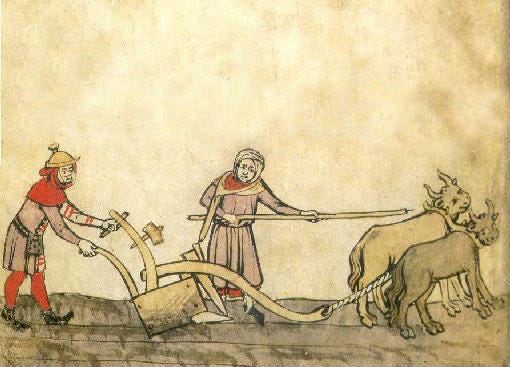
Here’s my plan: next week, I will share the first in a series of posts on William Langland’s landmark poem, Piers Plowman. Written towards the end of the 14th century, this long poem is an ideal way of orientating us as modern readers to some of the political, social and spiritual issues that were predominant in that era. Piers Plowman is sparklingly written, it is politically subversive, and it beats with a heart of social and spiritual sincerity that is refreshing and disarming.
As we will see in next week’s article, the poem has exerted a major influence on Western culture both in its immediate context and right through to our own day. Novelist Marilynne Robinson has cited the poem as being particularly influential on her own work and modern values, even suggesting its outlook contributed to abolitionism in the USA. I hope to show in the next article how this influence continues and why a figure like Piers could be viewed as crucially important to our understanding of the troubling days that democracy is passing through at present.
How you can be part of this
I would love you to be part of this series of articles, and join me in journeying into the medieval period. If getting to grips with a poem like Piers Plowman sounds like a challenge you would like to accept, there are a few things you can do as a fellow pilgrim.
The first is to obtain a copy of Piers Plowman. If you are new to medieval literature, I would urge you to pick up a translation, as the original language, while beautiful, could simply bar the door to your enjoyment of the work for now. AVC Schmidt’s translation is an absolute marvel, and I am certain that you won’t regret plugging into his version of the poem.
The second step you can take is to engage in some introductory work. There is a wonderful episode of In Our Time from the BBC that gives a great sense of what the poem is all about. Listening to this will provide some crucial context for your enjoyment of Langland’s work.
Finally, engage with what I will be sharing here each Friday on the poem. I would love you to be part of the ‘fair field full of folk’ who find their lives enriched by medieval texts. If there are things you discover in the poem that you would like to explore, or things I share about the poem that you would like to develop further, please interact via comments and messages, and that will hopefully allow a good conversation to get going. Also, if you find yourself writing about Piers Plowman and your reading of it, or you come across articles and research that are helpful, please share links so that everyone engaging with the material here can benefit from it.
Piers Plowman not only raises questions about how we see the world and navigate social issues, but it offers satisfying answers about how we direct our hearts in difficult times, how we understand our lives and work when corruption abounds, and how we critique the very structures that can hold humans back from flourishing. I hope to explore these kinds of issues here in coming days, and would love your thoughts and your voice on this important and often overlooked era.


Andrew, i really love the sound of this adventure, i have both original and translated upstairs and will look it out ( the original penguin classic edition). I'm a wish I was an academic of the medieval period. I didn't get past my ma in English local history but I have loved it throughout my life. I'm looking forward to next week and I'll look out In Our Time. - Good luck