

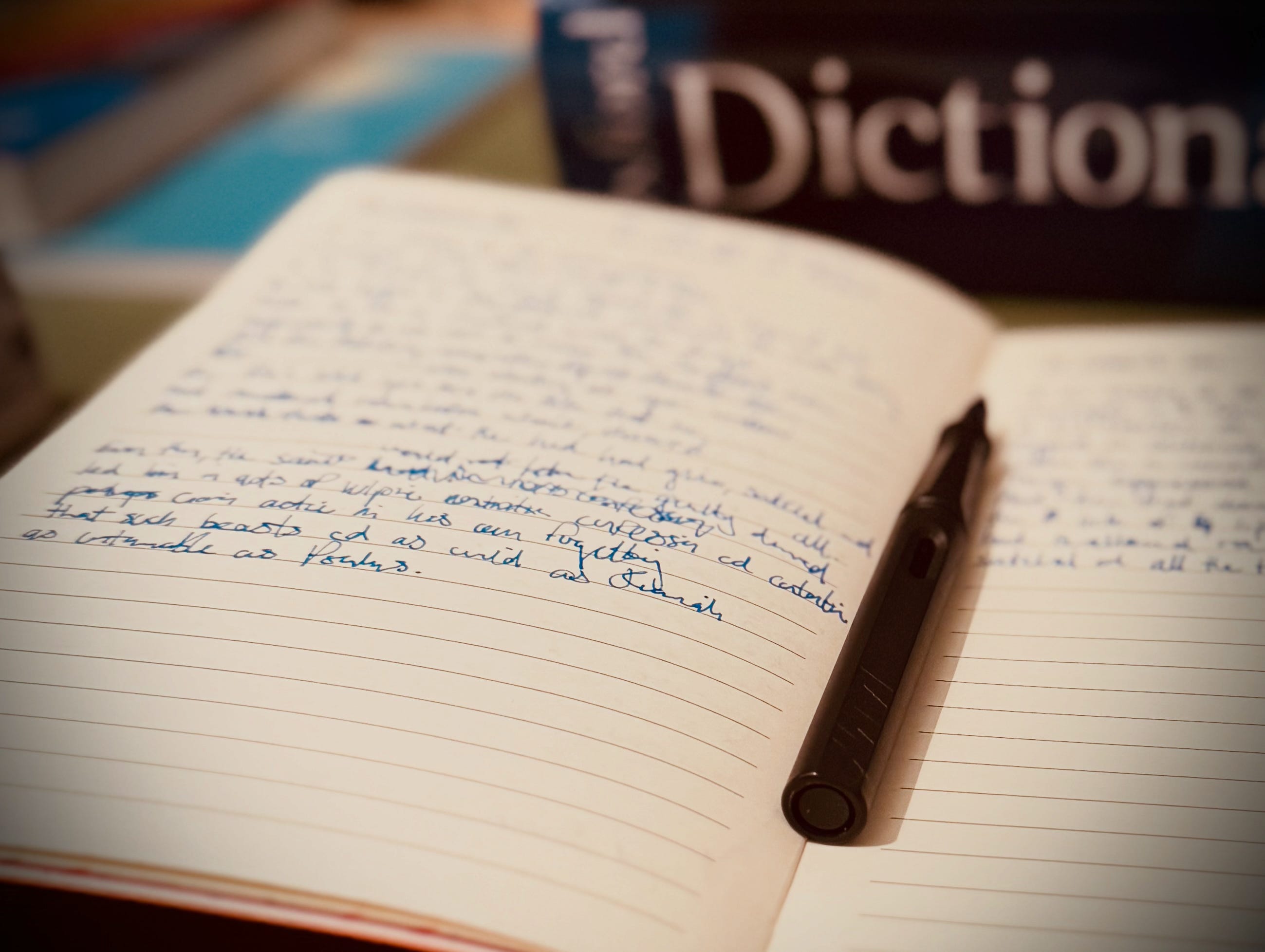
These days, it seems like I am writing an accidental series on creativity and AI. Given the prompt-input-response-output of Artificial Intelligence, a sequence of articles that land in the realm of happy accident feels like a protest in itself. In previous pieces, I have thought about ‘analogue algorithms’, the ‘cost of cutting copy’, and the sad reality of ‘mechanical providence’. In this article, I want to meditate on, and rejoice in, the painfully slow, setback-ridden reality of human creativity as we experience it in our lives, suggesting that our slowness, slackness and frustration are part of the glory of being a mere human being, rather than a mighty machine. Central to what I share below is the notion of not just trusting the processes that we must follow to make things, but treasuring them as an expression of our dignity and uniqueness as creatures.
Products without processes
I recently enjoyed listening to a conversation between Andy Crouch and Curtis Chang on the theme of Artificial Intelligence on the Good Faith podcast. Their specific focus was the effect that AI has on our minds as human beings. Andy Crouch’s reflections on the instantaneous and emotionally cost-free nature of AI output landed home with real force for me and made me grateful for the creative process in a fresh way. The great appeal of AI is that it seems to place us in a position of power in terms of creation, allowing us to sample on a small scale what it is like to say ‘let there be’ and to see in seconds that our command has been carried out. Whether we can declare what is produced at the end is ‘good’ or ‘very good’ is less certain.
Crucial to Crouch and Chang’s argument and to the theme of this article is that creative product without creative process is reductive, it supplants something essential and irreplaceable in the experience of being human and in the tasks of living and creating. For me the standout areas of deficit that the podcast identified lay in the categories of cost and growth.
As humans much of our creating, caring and relating is predicated on what these things cost and what they cultivate. The costs can be things like personal loss, the setting aside of our needs to minister to others, or the pursuit of an ethic or calling which denies us immediate or common benefits. Large Language Models can provide content and interaction at many levels beyond what humans are capable of, but there is neither sweat, blood, no tears locked into its provision. The process of meeting another’s needs, or bringing something creative into the world (be it a book, a child, a garden, a painting, a process of healing, the offer of care or education for others etc, etc) also cultivates something in us as human beings. Stretched by creative processes, feeling our inadequacy, pursuing the receding horizon of excellence, being broken through losses and life’s crosses, all generate things in us as people. Large Language Models might learn from each product completed but it will never live more fully as a result, never receive into itself the ‘becoming’ that process presses on our hearts, minds and bodies. This renders a cold world of outcome, the widening of knowledge without the deepening of wisdom, a body of work without the work of a body, the generation of concepts with neither conscience nor consciousness grown as a result. Products without processes might be spatially the same, but they are existentially different.
All my words come back to me in shades of mediocrity
As the foregoing suggests, this material from the Good Faith podcast has greatly stimulated my thinking. In the same period as I have been listening to these episodes, I have been diving ever deeper into literary biography and books by writers on writing. Both of these exercises have been pleasurable, but also newly informative about the happenstance, hardship, self-doubt, self-discipline, despair and deep-mined hope that creative work entails (what I share about these ingredients in the process of writing might just as easily apply to any other form of creative pursuit).
Over and over again, I have been reminded that many of the greatest works of literature on our shelves came not by the ruthless execution of ideas into words by great minds, but through the tough stuff of living as human beings in a hard world. Richard Ellman’s portrait of James Joyce’s life reveals a man whose fidelity to creative vision was mixed with setbacks, the crooked outcomes of his own character, mental and physical struggle, political and social upheaval and the dizzying complexities of maintaining good human and familial relationships. In 1906 he wrote to his brother Stanislaus of the conditions in which he was trying to create: ‘No pen, no ink, no table, no room, no time, no quiet, no inclination.’ Joyce is not alone in this; all creative work happens in non-ideal environments and is subject to the same slings and arrows - and this is precisely the point: the process is an irreplaceable part of works of human ingenuity and genius. The friction and resistance of our environment, the brokenness of our hearts, the swift infill of joy that we know on a new morning, the long nighttime loneliness of unsought waking hours, the successes and setbacks are all essential, vital to the work of creation.
Added to this is the influence of self-doubt, its paralysing and vivifying effect on the shape of our work, its double-tongued impetus and interruption of our content, the stop-start stagger of putting what we have made out into the world, all the while nursing Paul Simon’s confession that such things come back to us in ‘shades of mediocrity’. Even this part of the process is crucial to the work we do, and should be treasured. Machine responses do not deliberate as humans do; they do not embody the sweat-palmed anxiety of ushering something into a world which might love or hate it, they bear no emotional or relational connection to things they manufacture. The fact that we do all of these things ultimately enriches our work, and forms something deep and lasting in us as creators. It also gives us cause to marvel at the sheer magic and ‘givenness’ of the work that we eventually release, a fact that Alberto Manguel captures beautifully,
The most writers can do is learn the rules of grammar and spelling, and the art of reading. Beyond this, whatever excellence they may achieve will be the result of simply doing what they are trying to learn, learning to write by writing, in a beautiful vicious circle that illuminates itself at each new turn. “There are three rules for writing a good book,” said Somerset Maugham. “Unfortunately, no one knows what they are.”
Where machines work for product, we labour for formation - the internal formation of ideas, the external formation of created content, the internal return of what is built into us by the things we wrestle with, make known and form.
This speaks to all of us who seek to create good things in the world, be they lasting, passing, literary, familial, artistic, relational or ministerial. The process which can feel like wounding; the waiting and second guessing, the seeming wastage and futility that stalk our endeavours, and the beautiful work that follows are integral parts of how we make things. This is to be treasured and trusted, prized and praised, in a world which wishes to summon rather than fashion, dictate rather than deliberate, equivocate, and struggle. From my own perspective as a writer, this unique human trait delivers me from a mindset that insists that I love ‘having written’ rather than ‘writing’. When I’m in the weeds and beset by worries and doubts in myself and my words, at that precise moment I need to remind myself that this is part of what it is to be a human being, a human making. That tortured process is worth more than a million AI prompts and products, embodying as it does a process that is unique to us as flawed, fallible, gifted and glorious creatures.
If you have read and benefited from this piece or other recent articles and would like to support my work as a freelance writer, there are a couple of ways to do that. One is to subscribe so that you never miss an article. There is a free option and a paid option, and I would be honoured if you opt for either!
All of my content is original and makes zero use of AI in its production. I am grateful that New Grub Street is 100% human! Your moral support encourages me to keep at it, and your financial support opens up time for me to give myself to the research and writing that appears here and in other places too. I am so grateful for your partnership.
If you’d like to support my writing life but regular contributions aren’t possible, the ‘Buy Me a Coffee’ option allows you to leave a ‘tip’ for articles you have enjoyed. If you would like to do this, you can donate via the button below. Please note that ‘Buy Me a Coffee’ donations do not grant access to archived posts.
Thanks for writing this up. It’s an encouragement and reminder that I need. I reproach myself with the accusation that I love “having written” more than “writing”, and the loneliness and feelings of inadequacy that come in the making of even the humblest composition often win out. But you’re right, they shouldn’t, for the struggle is a crucial part of what makes the product valuable. That’s part of the “soullessness” of A.I. that we talk about, that and its inability to worship, to love, and rejoice.
I like the Good Faith podcast but hadn’t heard that episode yet. Lots of good stuff out there.